Building My Portfolio with AI Agents: A Journey of Discovery
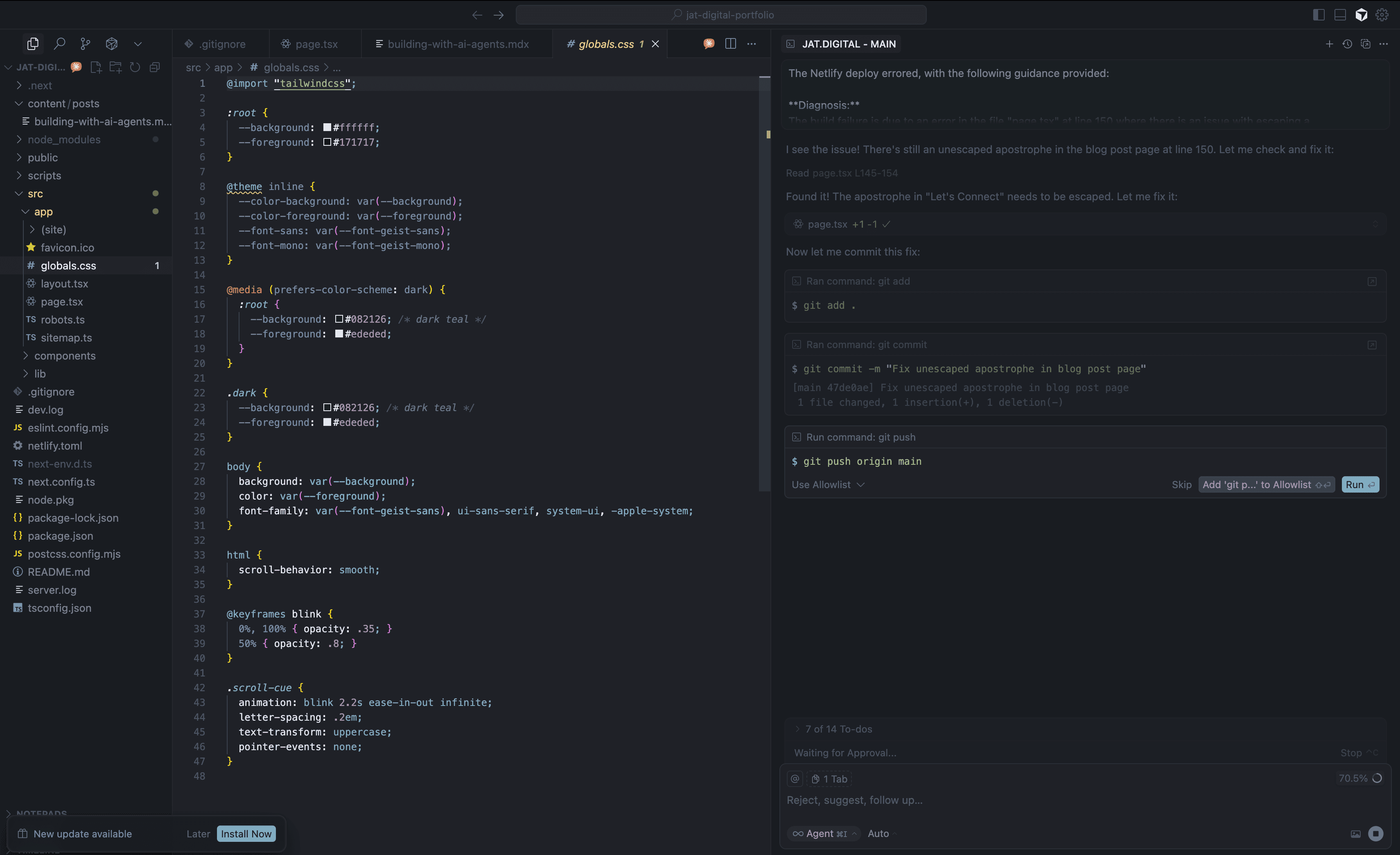
I recently took on a project to practice using LLMs and AI agents in real-world development. The goal? Build and deploy this entire portfolio website using Cursor and AI assistance. While it might not be the most impressive technical feat, the experience taught me invaluable lessons about the future of development.
The Learning Curve Was Real
Throughout this experience, I had to debug everywhere. I learned how to find what was wrong, where to send my agents, and how to make them work for me in the right places. While nothing is perfect, it's a solid draft that represents a new way of thinking about development.
I've done web development before—working with WordPress and various site builders—but nothing compares to this experience. We've unlocked a new era of development possibilities.
A New Level of Creativity
With AI agents, so many ideas flood my mind about the possibilities this career path holds. Creativity can now be taken to a new level with significantly less time investment. It's important to understand how these systems work, but mastering AI agents is a skill set I see becoming super prominent in the future.
As an early adopter, I'm making it my mission to learn exactly how I can use this technology to make my life more efficient as a practice. I'm also 100% willing to help make other people's lives more efficient in the same way.
The Reality of AI-Assisted Development
I'll be honest: I don't know a lot of code. While I can go through all my .tsx files, find what I need, and understand what's happening (which I feel is important), I wouldn't have been able to build this with just code—at least not this quickly.
My point is: I was able to create this with a little effort, some understanding, and a big vision. Only the future holds what these agents will be capable of doing.
The Next Step in AI and Automation
I believe this represents the next step in AI and automation. Knowing how to use these tools effectively is a skillset I deem as incredibly valuable. The ability to collaborate with AI agents, understand their capabilities and limitations, and guide them toward meaningful outcomes is becoming a core competency for modern developers.
What This Means for the Future
This experience has opened my eyes to the potential of AI-assisted development. It's not about replacing human creativity or problem-solving—it's about amplifying our capabilities and allowing us to focus on higher-level thinking while AI handles the implementation details.
The future of development isn't just about writing code; it's about orchestrating AI agents, understanding their strengths, and knowing when to guide them in the right direction.
This is just the beginning. I'm excited to continue exploring how AI agents can transform the way we build software and solve problems.
What are your thoughts on AI-assisted development? Let's connect and discuss the future of our industry.